
Description
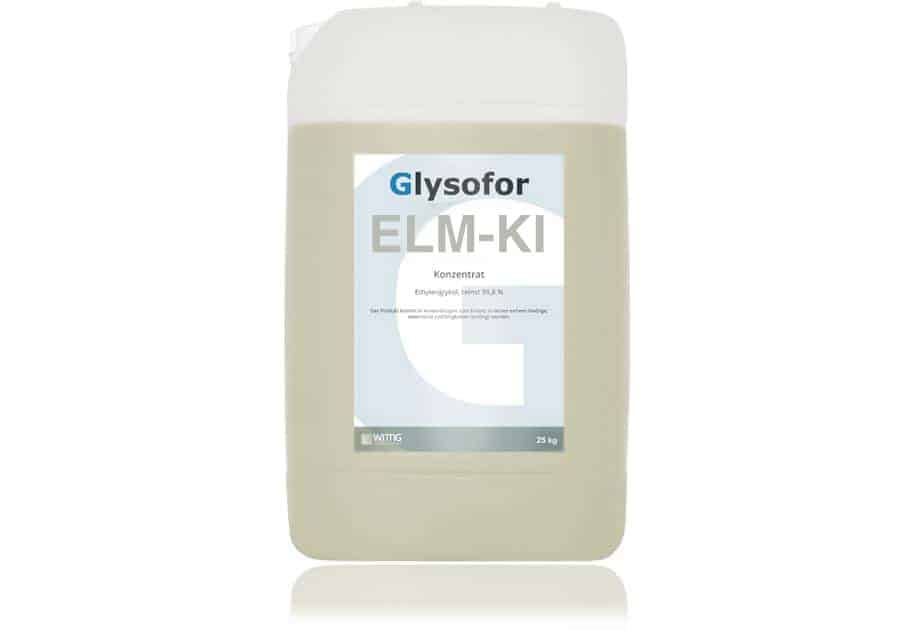
Glysofor ELM-KI is a high-performance, low-conductivity heat transfer medium based on high-purity monoethylene glycol, which has a particularly low electrical conductivity thanks to a special manufacturing process. At the same time, the product has a complex, conductivity-neutral corrosion inhibition, which ensures excellent corrosion protection for a wide range of metals and alloys typically used in water circuits and cooling systems. The inhibition is particularly effective for copper, brass, solder, steel, cast iron, and aluminum, regardless of the alloys present and also regardless of the weighting of the individual metal in the overall system.
The product is used in particular in technical applications where extremely low electrical conductivity is required.
Compared to MPG-based product variants, Glysofor ELM-KI is characterized by better overall thermodynamic properties, as it offers comparatively better thermal conductivity, lower viscosity, and better frost resistance. This results in maximum efficiency, which contributes to higher plant efficiency.
Glysofor ELM-KI is available both as a highly concentrated ultra-pure product and as a ready-to-use aqueous solution. The ready-to-use solutions are produced exclusively with ultra-pure water, which has an electrical conductivity of less than 0.1 µS/cm.
Glysofor ELM KI optimally prevents frost damage, corrosion, deposits, sludge formation, and biofilms in water circuits.
The product is classified in the lowest water hazard class WGK 1, both as a concentrate and when diluted with water.
| Specific electrical resistance at 20 °C (M ohm cm) | min. 10 |
| Specific electrical conductivity at 20 °C (μs/cm) | max. 0.1 |
| Dielectric constant | approx. 40 |
Glysofor ELM KI is miscible with water, ethanol, butanol, butyl acetate, and acetone in any ratio.
For subsequent adjustment of solutions, we supply high-purity water with an electrical conductivity of < 0.1 µs/cm.
Stationary systems operated with Glysofor ELM-KI do not require retention in accordance with §35 AwSV.
Typical areas of application
Aqueous solutions of Glysofor ELM-KI are used in water circuits where extremely low electrical conductivities are required.
Packaging sizes
- 25 kg / 30 kg PE canisters
- 220 kg PE drum
- 1,000 kg IBC
- 24,000 kg tanker truck
The thermodynamic properties and other specific product characteristics are available for download as a PDF file.
Frost protection
Depending on concentration
| Chemical Name | 1.2 Ethane diol |
|---|---|
| Appearance | Colorless liquid |
| Packaging | Canisters / drums / IBCs / tank trucks |
| ADR | KI 0 No. |
| WGK | 1 |
| Label |   GHS 07 – H302, GHS 08 – H373 GHS 07 – H302, GHS 08 – H373 |
Antifreeze
Glysofor ELM-KI significantly lowers the freezing point of water, preventing freezing in water circuits and cooling systems.
Water circuits can be temporarily shut down with Glysofor ELM-KI even in frosty conditions, but remain operational at all times. Homogeneously mixed aqueous solutions do not separate when the system is shut down.
Application in electromobility
Glysofor ELM-KI is the preferred coolant with very low electrical conductivity (< 100 µS/cm) for use in electric vehicles and high-voltage systems. In modern electric vehicles, precise and safe thermal management is crucial, as batteries, power electronics, and electric motors generate considerable amounts of heat during operation and charging.
Glysofor ELM-KI offers a high level of electrical safety, especially in cold plate battery cooling systems, where the coolant circulates in close proximity to high-voltage components. Its permanently low conductivity significantly reduces the risk of short circuits, electrochemical corrosion, and gas formation, even in the event of leaks.
Compared to conventional coolants, Glysofor ELM-KI supports efficient heat dissipation, stable operating temperatures, and thus consistent performance of battery and drive systems. This contributes significantly to the extended service life of critical components, energy efficiency, and operational safety of electric vehicles.
Glysofor ELM-KI meets the requirements of relevant international standards such as ASTM D8566 and GB/T 29743.2, making it ideal for use in future-oriented vehicle concepts and electrified platforms.
Advantages
• High electrical safety even in the event of leaks
• Permanently stable, low electrical conductivity
• Reliable corrosion protection for aluminum and copper
• High thermal and chemical stability
• Easy integration into existing cooling and thermal management systems
Result:
Greater safety, longer battery life, and reliable performance in modern electric vehicles.
Application in welding technology
Glysofor ELM KI is a liquid coolant for technical cooling systems with high thermal loads and increased requirements for media purity. It is particularly suitable for cooling liquid-cooled welding torch systems at high currents and long duty cycles, where gas-cooled systems reach their limits.
Thanks to its very low electrical conductivity, which is well below the recommended limits specified by equipment manufacturers, Glysofor ELM KI significantly reduces the risk of electrochemical corrosion. Copper, brass, solder, steel, iron, and aluminum components are reliably protected, while electrocorrosion, deposits, and blockages in the cooling system are significantly minimized.
Glysofor ELM KI ensures efficient heat dissipation, stable temperatures, and long-term protection of the welding torch, cooling circuit, pump, tank, cooler, and power source. It is designed for continuous operation in circulating cooling devices and liquid-cooled welding systems and represents a safe, long-lasting alternative to water.
Application in high-voltage electrical environments
Glysofor ELM KI has established itself as the preferred heat transfer medium for cooling applications in power electronics, especially in frequency converters, rectifiers, and medium- and high-voltage applications.
The product is used in direct cooling, for example in power semiconductors such as IGBT modules, cold plates, and cooling plates.
Due to its very low electrical conductivity and its complex inhibition, which deliberately avoids ionic components, Glysofor ELM KI reliably reduces the risk of creepage and leakage currents, the destruction of IGBT modules, and electrochemical corrosion on all materials used in the cooling circuit.
Thanks to its electrically insulating properties, the heat transfer fluid helps prevent galvanic corrosion in the long term, thereby supporting the insulation concept of the entire system.
At the same time, Glysofor ELM KI facilitates compliance with relevant standard requirements, for example with regard to insulation coordination, leakage current limitation, and protection against electric shock in accordance with IEC and VDE specifications, depending on the respective system design.
Due to its special formulation, Glysofor ELM KI has a conductivity of < 0.1 µS/cm, making it suitable for use in the primary circuit.
Application Guidelines
Galvanized components should be avoided, as zinc is generally incompatible with glycol and glycol-containing products.
This property also applies to all glycol-based antifreeze, since there is no manufacturer-specific inhibitor for zinc. Should a galvanized coating be damaged during system operation, the underlying steel would be protected by the inhibitor package.
If the zinc coating detaches, it will do so in very fine particles. These zinc particles are neutral with regard to the corrosion situation in the system and can be filtered out as needed.
Due to its extremely high purity, Glysofor ELM KI must not be contaminated with other products or substances. To maintain its low conductivity during system operation, it is possible to achieve continuous purity through ion exchange. Overheating and temperatures above the boiling point must be avoided, as this can lead to damage and premature aging.